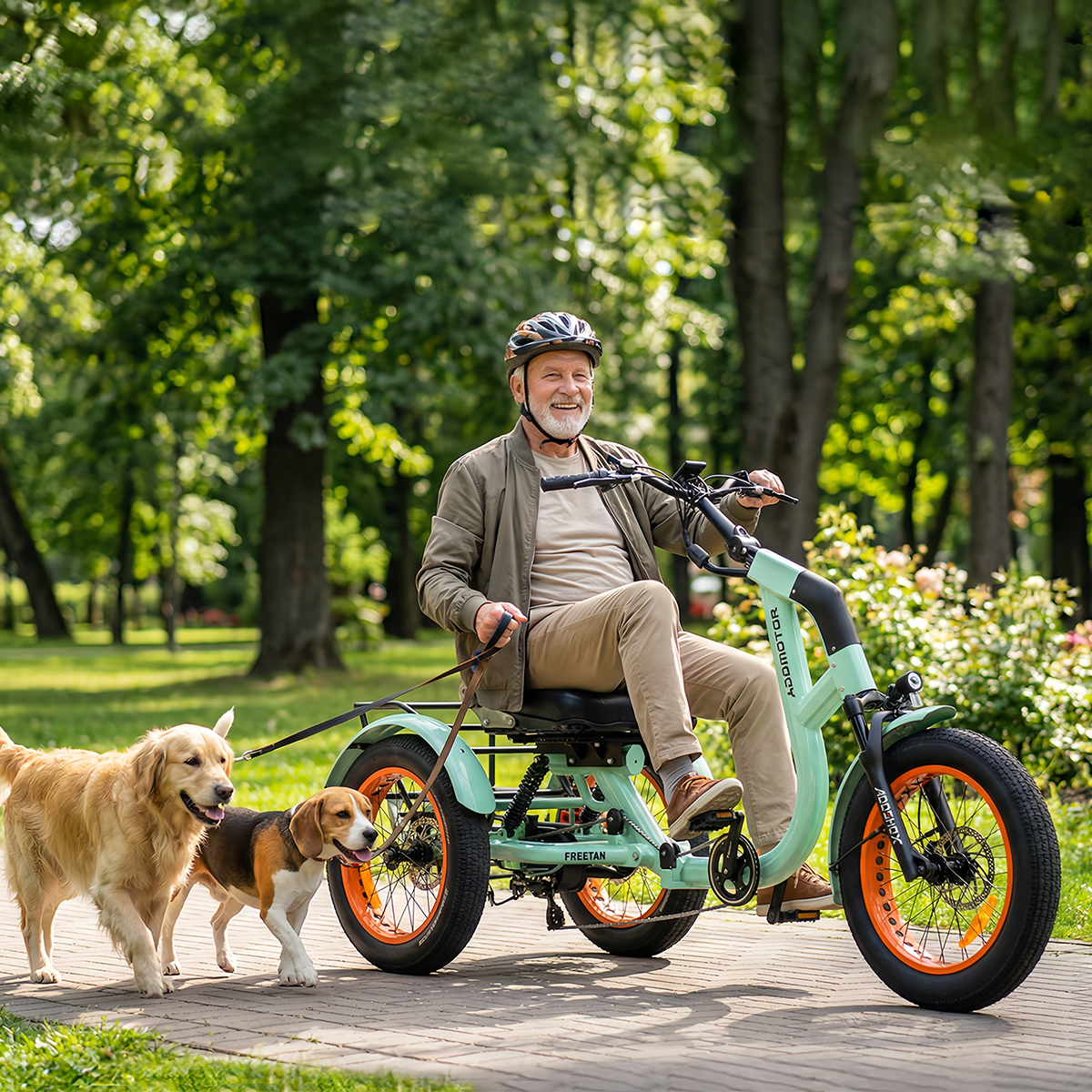
How The U-750 Tilting Trike Quickly Widens the Gap with Traditional Tricycles
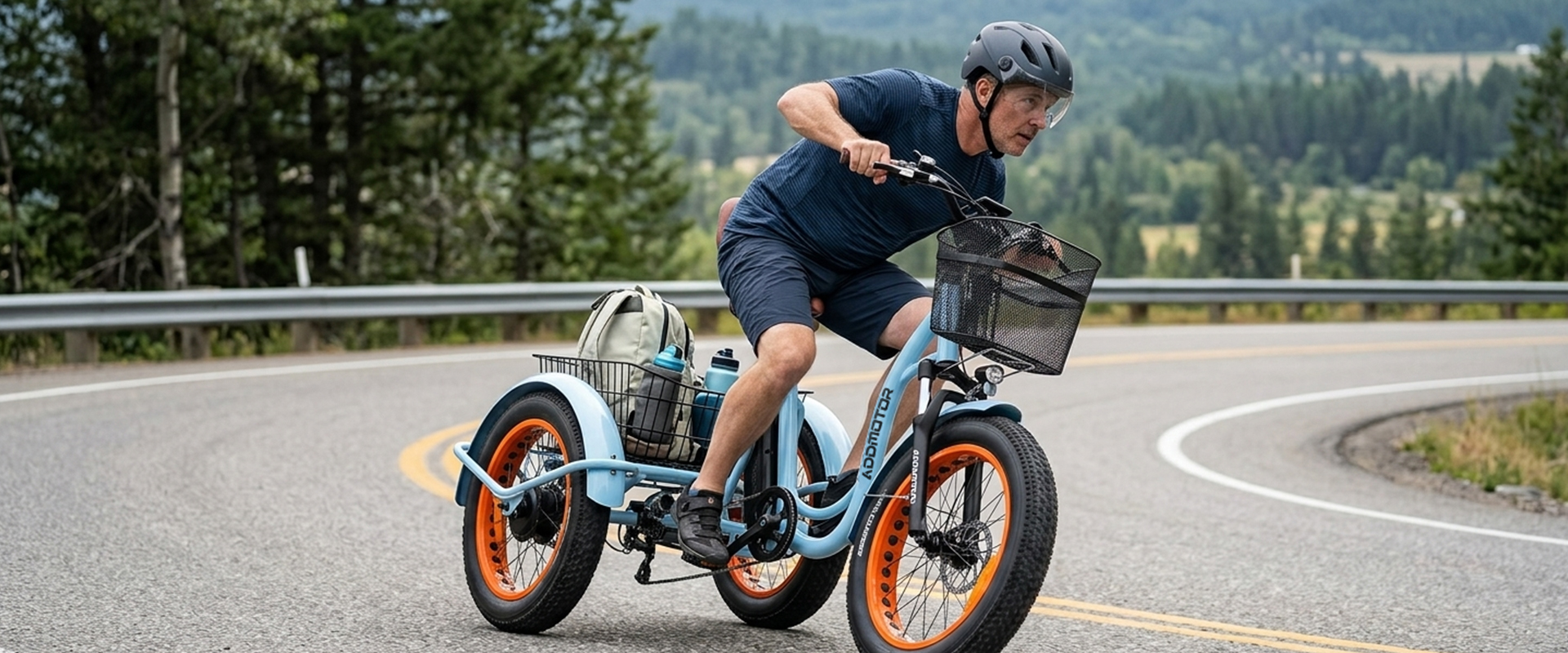
Table of Contents
- I. Widening the Gap with Traditional Tricycles
- II. The Hidden Problem in Traditional Tricycles
- III. Tilting Mechanism: Restoring Balance Through Motion
- IV. Engineering Summary Table
- V. A Dual-Mode Experience Tailored for Real-World Riding
- VI. Why the U-750 Uses Fat Tires
- VII. U-Trike U-750 Specifications
- VIII. Conclusion
I. How The U-750 Tilting Trike Quickly Widens the Gap with Traditional Tricycles
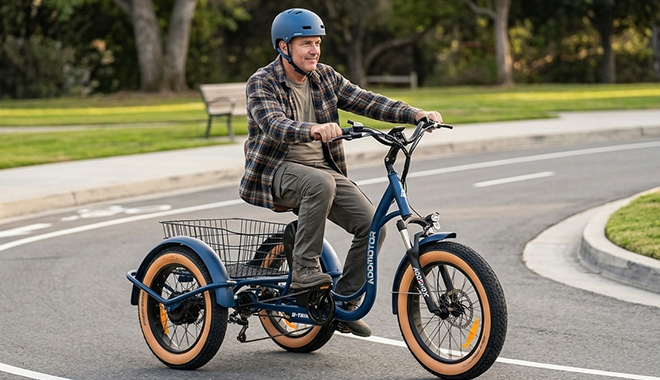
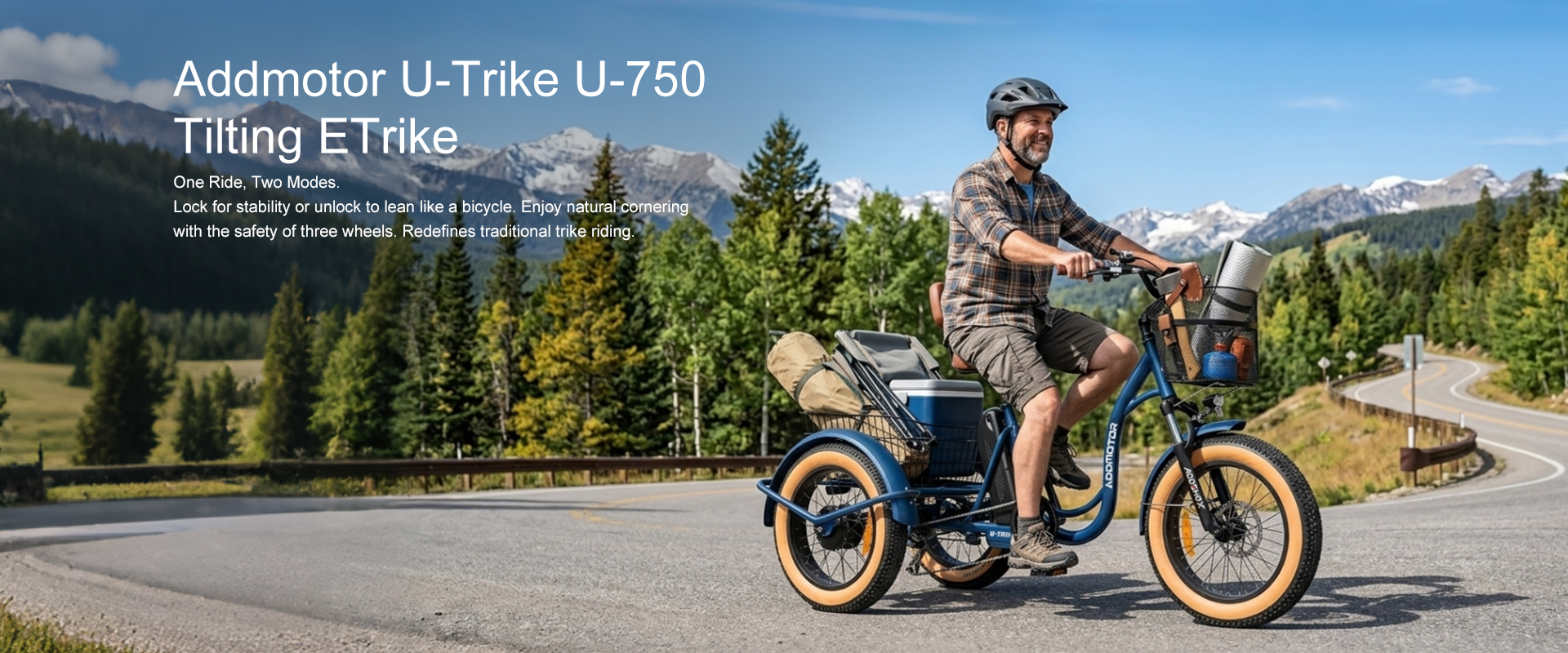
The U-750 Tilting Trike, launched by Addmotor in 2026, takes a fundamentally different approach from traditional electric tricycles. Instead of focusing on motor power or battery range, it improves how pedaling force is converted into motion.
When pedaling, the human body naturally generates alternating left-right forces. In conventional rigid-frame tricycles, this lateral force is not effectively converted into forward momentum. Instead, it is largely wasted, and can even create a sense of resistance or instability.
The U-750 addresses this by introducing a tilting mechanism. By allowing the frame to lean, the side-to-side forces generated during pedaling are redirected into forward motion. This makes power transfer more efficient while also allowing the rider’s body to move naturally with the bike, reducing stiffness and fatigue. In short, it’s not about adding more power—it’s about using existing power more efficiently.
II. The Hidden Problem in Traditional Tricycles: Motion Without Adaptation
Traditional tricycles are built on a rigid design philosophy. The frame remains upright, the rear wheels stay fixed, and the system prioritizes stability through structural immobility. At low speeds or when stationary, this approach works well—it provides confidence, predictability, and a solid riding platform. However, once the vehicle is in motion, this rigidity begins to reveal its limitations.
Real-world riding is not static. Every pedal stroke, every small shift in body weight, and every turn introduces dynamic forces into the system. The human body does not move in a perfectly linear way; instead, it generates alternating forces, subtle lateral motion, and continuous adjustments to maintain balance and efficiency. On a traditional rigid trike, none of these natural movements are accommodated. The frame resists them.
As a result, part of the rider’s input is not translated into forward motion. The side-to-side forces generated during pedaling are absorbed as upper-body sway rather than contributing to propulsion. Over time, this creates a riding experience that feels inefficient and slightly disconnected, as if the rider is constantly working against the machine rather than with it.
In essence, traditional tricycles achieve stability by preventing movement, but in doing so, they fail to adapt to the dynamic nature of real riding. Stability is maintained, but efficiency and fluidity are compromised. This is precisely where a tilting system changes the equation. By allowing controlled lean, a tilting trike no longer resists the rider’s natural motion—it works with it, transforming previously wasted movement and unbalanced forces into coordinated, efficient forward motion.
III. Tilting Mechanism: Restoring Balance Through Motion
At the core of the U-750 is a central pivot tilting mechanism that fundamentally reconfigures how a three-wheeled system manages dynamic forces. In a conventional rigid trike, the frame remains vertical during cornering, causing lateral acceleration to generate an outward inertial effect that shifts the center of mass beyond the support base. This creates an overturning moment that must be resisted through structural width and rider compensation, rather than being inherently resolved.
By contrast, the U-750 allows the rider and front frame to lean into the turn, actively reorienting the force system. As the vehicle enters a corner, the lean angle adjusts so that the combined effect of gravity and lateral acceleration aligns through the tire contact patch, minimizing the lateral moment arm and reducing rollover tendency at its source.
The condition for stable cornering can be expressed as:
tan(θ) = v² / (r · g)
where θ is the lean angle, v is velocity, r is the turning radius, and g is gravitational acceleration. This relationship defines the exact balance point at which the inward centripetal force generated through tire-ground interaction offsets the outward inertial effect.
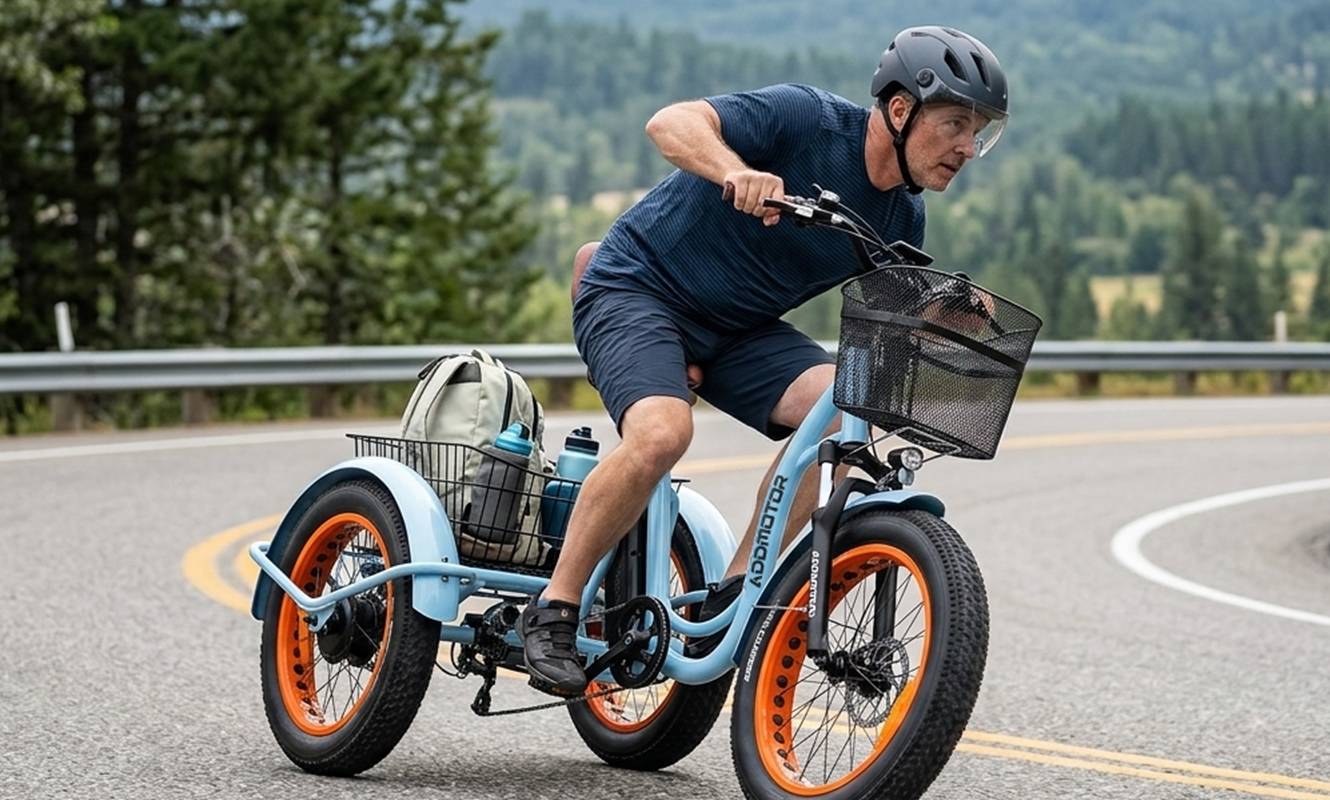
In a rigid trike, this condition cannot be satisfied because the system is constrained from leaning, forcing the rider to absorb the imbalance. In the U-750, however, the geometry of the vehicle adapts dynamically to meet this equilibrium condition. The result is a system that no longer relies on resisting instability, but instead prevents it by aligning forces at the source—delivering a cornering behavior that is both mechanically stable and intuitively natural.
IV. Engineering Summary
| Aspect | Traditional Trike | Tilting Trike |
|---|---|---|
| Force alignment | Misaligned | Aligned with turn |
| Center of gravity | Outside turn | Shifted inward |
| Stability method | Resist rollover | Prevent rollover |
| Rider role | Passive | Active |
| Cornering physics | Unfavorable | Optimized |
V. A Dual-Mode Experience Tailored for Real-World Riding
One of the most thoughtful aspects of the U-750 is its dual-mode system, designed not just as a feature, but as a practical solution for different riding scenarios.

In Fixed Mode, the pivot mechanism is locked, and the trike behaves like a traditional rigid three-wheeler. This mode is ideal in situations where maximum stability and predictability are required. For example, when starting from a complete stop, riding at very low speeds, or navigating crowded environments such as sidewalks, parking areas, or busy urban streets, keeping the frame upright provides a strong sense of control.
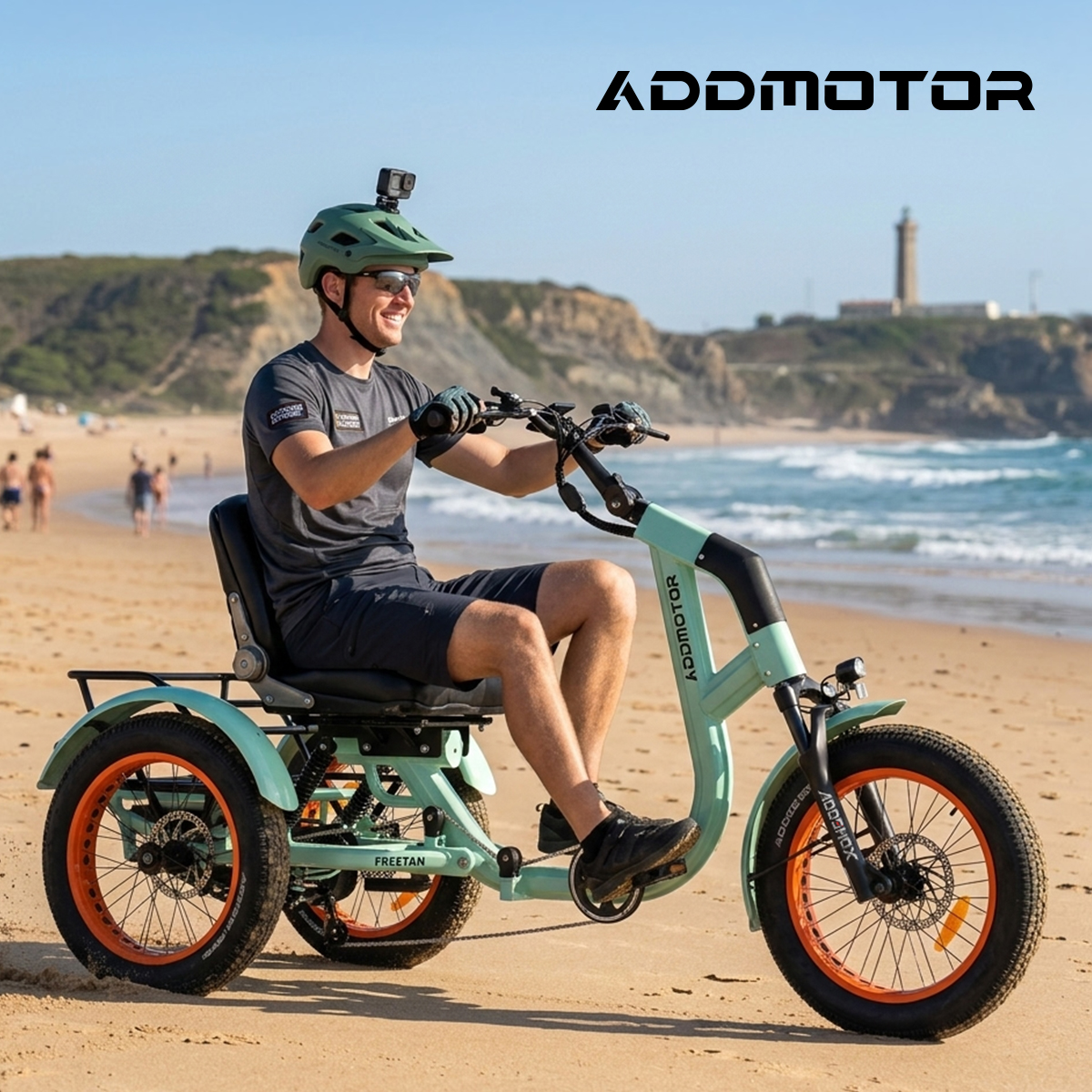
In contrast, Tilting Mode is designed for open-road riding and more fluid movement. Once the rider reaches a steady pace or enters less congested environments—such as bike lanes, suburban roads, coastal paths, or park trails—the tilting mechanism can be unlocked. In these conditions, the ability to lean transforms the riding experience. Cornering becomes smoother, body movement feels natural, and the “thrown outward” sensation typically associated with rigid trikes is significantly reduced.
The real advantage lies in the ability to switch between these two modes depending on context. A rider might begin a trip in Fixed Mode while navigating tight spaces, then transition into Tilting Mode once the road opens up. This flexibility allows the U-750 to adapt not only to different riders, but to different moments within the same ride—bridging the gap between cautious stability and active, engaging motion.
VI. Why the U-750 tilting trike Uses Fat Tires: Stability Across Real-World Terrain

The U-750’s 20" × 4.0" fat tire setup is not just a styling choice—it’s a functional decision made for real riding conditions. Unlike narrow tires that perform best on perfectly smooth pavement, fat tires are designed to handle the variety of surfaces riders actually encounter: cracked city roads, uneven sidewalks, gravel paths, park trails, and even sand-dusted coastal routes.
The wider tire creates a significantly larger contact patch with the ground. This directly increases friction and grip, which becomes especially important in a tilting system. When the rider leans into a turn, the tire must maintain stable traction at an angle. Fat tires provide a more forgiving grip margin, reducing the chance of slipping and making the lean feel controlled rather than abrupt.
They also improve comfort and stability in less predictable environments. The higher air volume inside the tire acts as a natural cushion, absorbing small bumps, road imperfections, and vibrations before they reach the rider. This is particularly beneficial when carrying cargo or riding for longer distances, where constant micro-shocks can lead to fatigue. In short, fat tires allow the U-750 tilting trike to maintain stability not just on ideal roads, but across the full range of environments riders actually use—making the tilting system safer, smoother, and more accessible.
VII. U-Trike U-750 Specifications
| Component | Specification Details |
|---|---|
| Battery | 48V 20Ah Samsung UL-certified battery |
| Motor | 48V 750W rear-mounted motor |
| Range | 40–85 miles per charge |
| Sensor | High-precision torque sensor |
| Controller | Addmotor 25A controller |
| Display | Addmotor 5-inch LCD display |
| Throttle | 1/2-twist variable-speed throttle |
| Charger | 48V 2.0A 5-pin U.S. standard with magnetic suction |
| Frame Material | 6061 aluminum alloy |
| Steering | Central pivot tilting mechanism |
| Suspension | Front oil spring fork with 80mm travel |
| Net Weight | 167.55 lbs (76 kg) |
| Payload | 450 lbs (350 lbs rider + 100 lbs cargo) |
| Front Tire | 20" x 4.0" fat tire |
| Rear Tires | 20" x 4.0" fat tires |
| Brakes | Mechanical disc brakes on each wheel |
| Parking Brake | Integrated locking brake system |
| Gearing | Shimano 7-speed system |
| Chain | KMC stainless-steel chain |
| Headlight | 40 LUX, battery-powered |
| Taillight | EB 2.0 5-in-1 with turn signals and brake light |
| Signature Colors | Avocado Green, Bay Blue (with orange rims) |
VIII. Conclusion
Compared to traditional rigid tricycles, a tilting trike delivers a fundamentally more refined riding experience. By allowing the rider to lean into turns, it effectively reduces the outward “throwing” sensation that is common on conventional three-wheelers, resulting in noticeably better cornering control and stability in motion. At the same time, the riding dynamics become more natural and intuitive, as the body and vehicle move together rather than working against each other. Combined with wide tires that enhance grip and absorb road irregularities, the overall ride feels smoother, more controlled, and less fatiguing over longer distances.
In essence, it offers stronger cornering performance, a more engaging and intuitive riding experience, and a significantly more comfortable ride with reduced vibration.